Communication for all, not some
Last Updated: November 2026
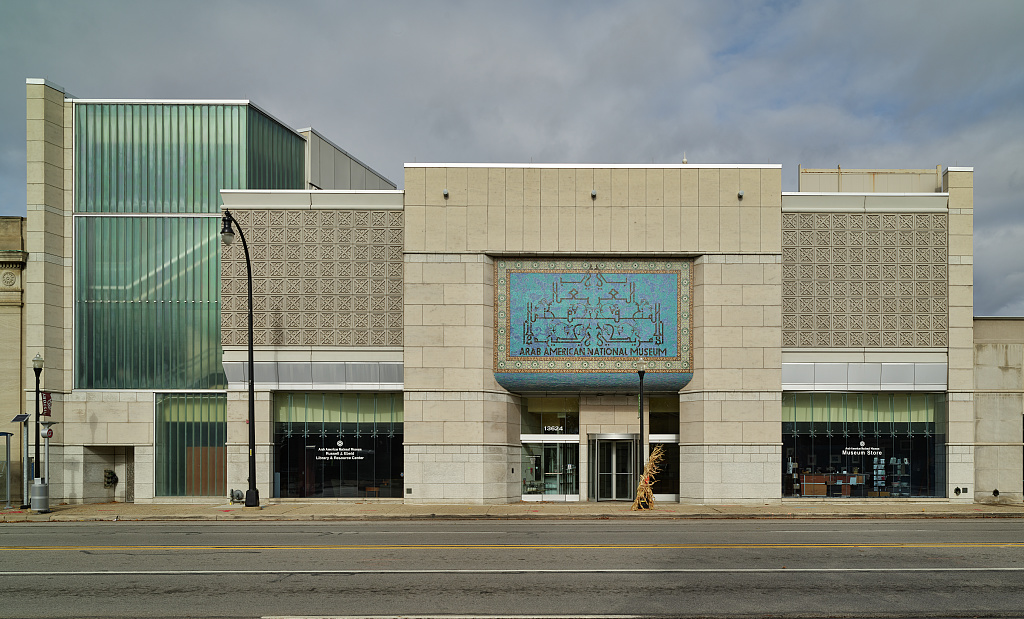
Arab American National Museum, Dearborn. Photo: Carol M. Highsmith, Library of Congress, public domain
 everyone
 talk
 language
 hello
 together
 world
Six tiles from a MoCo board. Today every one of them is labeled in English.
We built Model Communicator because communication is a right, not a privilege. Then we built the whole thing in English.
We wrote that first sentence on our home page. This page is about closing the gap between it and the second one: how we plan to do it, and what we are not willing to pretend along the way.
The short version: Model Communicator will carry language packs. Some will be reviewed by a native-speaking speech-language pathologist. Others are drafted with AI and clearly labeled until a clinician in that language signs off, and we are working toward native-speaker review of every one. Fourteen betas are live today: Spanish, Portuguese, French, German, Dutch, Italian, Arabic, Hebrew, Cantonese, Japanese, Korean, Hindi, Swahili and Chuj. None has had its native-speaker review yet. No AI service receives the words anyone says.
Where We Are Starting From
We are two native English speakers in Michigan. Kara is a speech-language pathologist trained in English-language AAC. Jim is an engineer. Neither of us can tell whether a Somali core vocabulary is right. That is the honest starting point for everything below.
We also know this: the gap in AAC access we see in the United States, where a family can wait months for an evaluation and a dedicated device can cost thousands of dollars, is the mild version. Almost everywhere else it is worse.
The Gap, in Numbers
Every figure here is linked in the sources at the end of this page.
People who need AAC
The standard estimate, from Beukelman and Light, is that more than 97 million people worldwide cannot rely on speech alone to be heard and understood, including roughly 5 million in the United States. Nobody collects uniform data on this population, so the real number may well be higher.
Access to assistive technology
The WHO and UNICEF Global Report on Assistive Technology (2022) found that about 2.5 billion people need at least one assistive product, and nearly one billion are denied access. In the 35 countries it compared, access ranged from 3 percent in the poorest to 90 percent in the wealthiest.
People who can help
A 2021 study by World Health Organization researchers found that most countries in the African Region have fewer than one speech-language therapist per million people, while most European countries have up to 50 times more. The United States has more than 600 per million. In many places there is no professional to wait for.

Cost
The same WHO and UNICEF report found that about two thirds of people who have an assistive product paid for it out of their own pocket. It also found large gaps in services and trained workforce, especially for cognition, communication and self-care.
Languages
Robust AAC systems are usually built in English first, and a few other widely spoken languages follow. The world has more than 7,000 languages. For the great majority of them there is no robust AAC system at any price.
Technology
An AAC device cannot work without an offline voice. The voices built into tablets and laptops cover dozens of languages, not thousands, and large AI models are fluent in a few dozen and unreliable beyond them. The languages with the least AAC are also the ones with the least technology support.
Put those together and the picture is simple. In the places with the most people who need AAC and the fewest professionals to help them, there is also no software in their language. A free English app does nothing for them.
What We Are Going to Do
One app, every language as a pack
We are not building a Spanish MoCo and a Hindi MoCo. Model Communicator will carry language packs, chosen per profile, so a bilingual household uses one device and a child's words travel with them.
A pack is not a translation. It has its own core words, its own grammar and its own layout decisions, on the same frame that repeats on every MoCo page.
Two Tiers, Labeled Honestly
Every language is in one tier or the other, and the app says which.
Reviewed languages
- A native-speaking speech-language pathologist has made the core vocabulary, grammar and layout decisions.
- The same standard as English.
- No warning label.
Community languages
- Languages where we could not yet find or afford a speech-language pathologist.
- Drafted with AI. We are working toward having at least two native speakers review every one. The betas live today were released before that review, and the table below says so for each.
- A visible label that says how far review has come. Today every one is marked beta. Once native speakers have reviewed a pack, its label will read: “Community language. Drafted with AI, reviewed by native speakers, SLP review pending.”
- An acknowledgment screen the first time a profile selects the pack, so nobody chooses one without knowing what it is.
- The label stays until a qualified clinician in that language signs off.
Where Each Language Stands
Fourteen betas are live. None has had its native-speaker review yet. We will keep this table current.
| Language | Status | Who has reviewed it |
|---|---|---|
| English | Reviewed | Kara Cotter, MS, CCC-SLP |
| Spanish | Beta. You can try the Spanish beta today, on the web and the iPad. | No native speaker yet. It stays marked beta until its review. |
| Portuguese (Brazil and Portugal) | Beta, web only. Try the Portuguese beta. | No native speaker yet. It stays marked beta until its review. |
| French (France and Québec) | Beta, web only. Try the French beta. | No native speaker yet. It stays marked beta until its review. |
| German (Germany, Austria and Switzerland) | Beta, web only. Try the German beta. | No native speaker yet. It stays marked beta until its review. |
| Italian | Beta, web only. Try the Italian beta. | No native speaker yet. It stays marked beta until its review. |
| Arabic (Levantine) | Beta, web only, right to left. Try the Arabic beta. | No native speaker yet. It stays marked beta until its review. |
| Cantonese (Hong Kong) | Beta, web only. Try the Cantonese beta. | No native speaker yet. It stays marked beta until its review. |
| Japanese | Beta, web only, in kana. Try the Japanese beta. | No native speaker yet. It stays marked beta until its review. |
| Korean | Beta, web only. Try the Korean beta. It speaks politely by default; a setting switches to plain speech. | No native speaker yet. It stays marked beta until its review. |
| Hindi | Beta, web only, in Devanagari. Try the Hindi beta. | No native speaker yet. It stays marked beta until its review. |
| Swahili | Beta, web only. Try the Swahili beta. Most devices have no Swahili voice, so where there is none it speaks with a Spanish voice reading respelled words. | No native speaker yet. It stays marked beta until its review. |
| Hebrew | Beta, web only, right to left. Try the Hebrew beta. | No native speaker yet. It stays marked beta until its review. |
| Dutch | Beta, web only, with a Flemish setting. Try the Dutch beta. | No native speaker yet. It stays marked beta until its review. |
| Chuj (San Mateo Ixtatán) | Beta, web only. Try the Chuj beta. There is no Chuj voice, so it speaks with a Spanish voice, and about half its words are the Spanish words Chuj-speaking children use. | No native speaker yet. It stays marked beta until its review. |
Where the betas fall short of this plan. They were released before step 4 below, so that native speakers have something real to correct. Each one is a separate board at its own address, not yet a pack chosen per profile. The “report a word” button is not built yet; until it is, email us. Every beta says on its first screen that it is a beta and links back to this page.
How a Community Language Gets Built
Seven steps, the same for every community pack.
Start from the structure, not from English words
Which concepts belong in a core set, how a grid supports sentence building, and how the frame repeats on every page are decisions about language in general. We keep those.
Draft with AI
We use large AI models to draft the core word set, tile labels, grammar notes and a starter set of everyday phrases in the target language. We ask the models to flag where the language does not map onto English structure, for example classifiers, gender, verb systems or word order.
Compare with a second model
Where a model built in or for that language exists, we run the draft through it too. Disagreements between the models become the review list.
Pay native speakers to review it
At least two native speakers of the language review the core set and a set of model sentences. Two native speakers of any background is the minimum. We look for bilingual speech-language pathologists, linguists or teachers, and we want at least one reviewer with a clinical or linguistics background wherever we can find one. We publish who reviewed each pack and what changed.
Check for an offline voice
We check that an offline voice exists for the language on the devices we support. If there is no usable voice, we do not ship the pack, because a communication device that cannot speak is not one.
Ship it with the label
The pack goes out with its community label, the acknowledgment screen, a public changelog and a “report a word” button on every tile. Every report is read by a person.
Move it up when a clinician reviews it
When a clinician in that language is willing to review, we move the pack to the reviewed tier and credit them.
What this is and is not
A community language pack is a starting point for a family who would otherwise have a translation app and nothing else. It is not a clinically validated system.
We think an imperfect vocabulary a family can start modeling today, clearly marked as imperfect, is better than nothing. We also think that is a judgment a family and their community should get to make with full information, which is why the label is not optional and not small.
The Problems We Expect
We would rather tell you now than have you find out.
AI is weakest where the need is greatest
The same models that are fluent in Spanish or Arabic are far weaker in Hmong or Haitian Creole. The languages with the biggest gap are the ones where automated drafting is least reliable. Native-speaker review matters most exactly where it is hardest to arrange.

Models make things up
A language model will produce a confident, grammatical, wrong word. Comparing models catches some of this. Native speakers catch more. Neither catches everything. The report button is how we catch the rest.
Core words are not a translation
The few hundred words a child combines to build sentences are different in every language, and so is the way they combine. A pack that puts English grammar under Somali labels teaches the wrong thing. This is the problem we care most about, and native-speaker review alone may not solve it, because it takes someone who understands both the language and how children build sentences in it.
Culture lives in the symbols
Our symbol set was drawn for a Michigan classroom. Food, clothing, homes, gestures and family structures will not match everywhere. Community packs will need symbol substitutions, and we will take them from the community rather than guess.
No voice, no device
Offline text-to-speech does not exist for many of the languages that most need it. We will say so on the language list rather than ship a silent pack.
Our own field is divided
Many speech-language pathologists are deeply uneasy about AI anywhere near a non-speaking child's words, for good reasons. We share some of that unease. Our answer is that AI only helps us draft the dictionary, before a pack ships. No AI service receives what a person says, the person still chooses every word, and a human still decides what goes on the board. See Use of AI.
Why We Are Doing It Anyway
Because the alternative is to wait for a world with enough speech-language pathologists in every language, and that world is not coming soon. Because a free app that needs no account and no connection is already the thing that can reach a family in a place with no services. Because we would rather be transparently imperfect than quietly absent.
And because this is how the reviewed tier gets built. The community packs are what let us find the bilingual speech-language pathologist in Lagos or Manila or Dearborn who sees a pack in their language, finds the mistakes and offers to fix them. We cannot hire our way to every language. We can build something worth correcting.
 find
- wrong
 tell
 fix
Find it, tell us, we fix it. That is the whole plan for getting better.
What We Are Asking
Email jim@modelcommunicator.com with “Languages” in the subject.
If you speak a language we do not
If you are a speech-language pathologist, linguist or teacher who speaks a language we do not, we would like to hear from you. We will credit you, pay you where we can, and put your name on the pack.
If your family uses a community pack
Tell us what is wrong. Every report is read.
If you think this is a mistake
If you are a clinician who thinks this is a mistake, tell us that too. We are listening, and the label is there because of you.
Sources
If a number on this page is wrong, tell us and we will correct it.
- Beukelman, D. R., & Light, J. C. (2020). Augmentative and Alternative Communication: Supporting Children and Adults with Complex Communication Needs (5th ed.). Paul H. Brookes. Source of the 97 million and 5 million estimates.
- World Health Organization & UNICEF (2022). Global Report on Assistive Technology. Need, access, out-of-pocket cost, and the service and workforce gaps.
- Kamenov, K., Martinez, R., Kunjumen, T., & Chadha, S. (2021). Ear and hearing care workforce: Current status and its implications. Ear and Hearing, 42(2), 249–257. Speech and language therapist density, from 124 countries.
- Wylie, K., McAllister, L., Davidson, B., & Marshall, J. (2018). Communication rehabilitation in sub-Saharan Africa: The role of speech and language therapists. African Journal of Disability, 7, a338. Estimates 0 to 6 speech and language therapists per million people in sub-Saharan Africa.
- American Speech-Language-Hearing Association. 2025 Member and Affiliate Profile (year-end 2025 counts). 216,272 certified speech-language pathologists in the United States at the end of 2025.
Companion Pages
This page belongs with three other commitments we have written down.

Frictionless Philosophy
Nothing to buy, nothing to approve, nothing to wait for. How we remove the friction that keeps AAC from the people who need it.
Use of AI
Exactly how we used AI tools to build Model Communicator, and confirmation that no AI service receives what you say.
Carbon Commitment
Where our footprint comes from, and our plan to move development to small, local, open-source models.
Speak a language we do not?
Help us get it right. We will credit you, pay you where we can, and put your name on the pack.