
Free Cantonese AAC: a communication board built for spoken Cantonese
If you are a speech-language pathologist with Cantonese-speaking families on your caseload, or a parent who wants your child to communicate in the language you speak at home, MoCo has a Cantonese board you can open today. It is free, it is written the way Hong Kong children actually talk, and it is honest about being a beta.
Free in Cantonese, the same as in English
Model Communicator (MoCo) is a free AAC app built with a speech-language pathologist. The Cantonese board costs nothing, the same as the English one: there is no paid tier, and nothing is held back for later purchase. You do not need an evaluation, a funding request or an account to start.
The Cantonese board is on the web only for now. It runs in the browser on a Chromebook, a Windows or Mac computer, an Android tablet or phone, or in Safari on an iPad, and you can add it to the home screen. It is not inside the iPad App Store app yet. After the first visit it keeps working without a connection in that same browser. It speaks with the Hong Kong Cantonese voice already on the device.
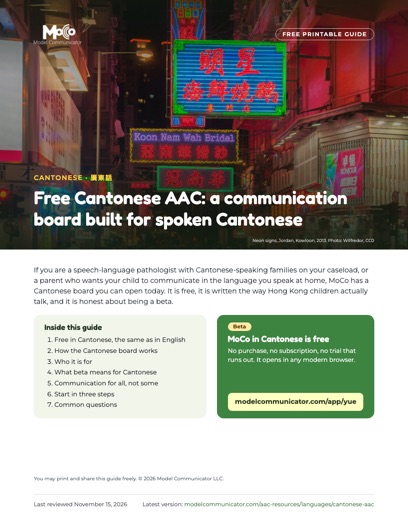

Free printable guide
Take this guide with you
Everything on this page as a 6-page PDF: how the board works, who it is for, what beta means, and how to start. Print it for a family or a team meeting, or share it.
How the Cantonese board works
A translated English board gives a Cantonese-speaking child English grammar with Chinese labels. This board keeps the MoCo layout (a frame of core words that never moves, around pages of topic words) and rethinks what goes in it for Cantonese, a language with no verb endings and no articles, but with classifiers, aspect markers and sentence particles.
The same frame as English, in Cantonese
The top row is 我 · 係 · 喺 · 有 · 可以 · 一個 · 呢個 · 同, cell for cell where the English board has I, am, is, are, can, a, the, and. Cantonese has no articles, so 一個 (one) and 呢個 (this) stand in their cells, and “to be” splits into 係 (is), 喺 (is at) and 有 (has, there is). The who column on the left is 你 · 佢 · 我哋 · 佢哋. He, she and it are all 佢, so the freed cells hold “we” and “they”. The corner word is 畀 (give, to a person).
- 我要飲水I want to drink water
- 媽咪喺邊度where is Mummy?
- 畀我give it to me
Written the way a Hong Kong child talks
Hong Kong schools write standard Chinese, but children speak Cantonese, and the two use different everyday words. The tiles show spoken Cantonese in Traditional characters: 佢, 唔, 冇, 咗, 喺, 嘅, 啲. The message bar joins the words with no spaces, as Chinese is written, and uses full-width punctuation. The topic pages carry a Hong Kong childhood: 菠蘿包, 蛋撻 and 魚蛋, 港鐵 and 小巴, 利是, 八號風球, both pairs of grandparents (嫲嫲 爺爺 and 婆婆 公公) and 姐姐 for the family’s helper.
- 我唔要I don’t want it
- 佢打我he hit me, or she hit me
- 冇喇all gone
The board says what was tapped
Automatic grammar is off unless you turn it on. The message shows exactly the words the communicator chose, so you can see their real language level and model the next step yourself. Families who want the board to finish the sentence can switch that on in Settings. In full, it adds 好 before a describing word (我好開心), puts in the classifier (兩隻狗), adds 嘅 for belonging, and turns a tapped question mark into the usual Cantonese question (你要唔要呀?). A lighter setting changes only classifiers and 冇.
No verb endings: aspect and “not” instead
Cantonese verbs never change for person or tense. A verb tile shows the bare verb (食, 飲, 玩). Tap it and its forms appear beside the board: done, doing, done before, and not. Press and hold it and every form opens as tiles. A tense key switches the column to past forms or to future forms such as 會食. Describing words work the same way, with a degree word in front.
- 食 → 食咗 · 食緊 · 食過 · 唔食eat: ate, is eating, has eaten before, does not eat
- 冇食did not eat
- 會食will eat
- 開心 → 好開心 · 唔開心 · 太開心happy: happy, not happy, too happy
Classifiers and sentence particles
Every noun in Cantonese has a measure word, and the board knows each one: 隻 for a cat, 本 for a book. Tap a noun and the column offers it with its classifier. The bare classifier before a noun is how Cantonese says “the”. A measure-word page (量詞), reached from Pronouns, holds the common ones on their own. The particles that end most Cantonese sentences, 呀 啦 喇 喎 囉 咩 㗎 嘛, are tiles on the Verbs page, next to the aspect markers 咗 緊 過 完.
- 隻貓 · 一隻貓 · 呢隻貓 · 啲貓the cat, a cat, this cat, the cats
- 一本書a book
- 我食完喇I have finished eating
Jyutping, the keyboard and the voice
A setting adds a line of Jyutping under each word, for adults who are learning the board or who read Cantonese better by sound than by character. It is off at first, and it is never spoken or added to the message. The keyboard types in Jyutping and offers board words as you type; tone numbers are optional. You can also write a word by hand. The board speaks with the device’s Hong Kong Cantonese voice. Check that one is chosen in Settings, because a Mandarin voice reads these words wrongly.
- 食 sik6the tile for “eat” with its Jyutping line
- sik → 食 · 熄 · 識typing sik offers eat, switch off, know how
- maami → 媽咪typing without tone numbers finds Mummy
Who it is for
Speech-language pathologists
You do not need to speak Cantonese to get a family started. The frame matches the English board, so what you know about modeling on MoCo carries over, and the family can model at home in the language they actually use. Because the board does not correct what was tapped, what you see in the message bar is what the child produced. The Jyutping line helps you follow along. There are three sizes: 60 tiles, and beta boards of 42 and 25.
Parents and families
Your child does not have to choose between Cantonese and English. Children can learn AAC in two languages just as they learn to speak in two. Open the board, touch words as you say them during meals, play and bath time, and do not ask your child to copy you. You can start tonight, before any evaluation.
Bilingual classrooms
English and Cantonese are separate boards with the same layout, each with its own settings and profiles. The Language setting opens the other one. The Cantonese board runs in the browser, so it works on school Chromebooks and tablets, and it keeps working offline after the first visit.
What beta means for Cantonese
The Cantonese board has not been reviewed by a native Cantonese speaker or by a Cantonese-speaking speech-language pathologist, and it stays marked beta until it has been. It was drafted with AI from Cantonese grammar and from knowledge of the words young children use most. English is the only MoCo board that has been fully reviewed. Some words, characters or Jyutping readings may be wrong.
Some limits to know about. The sentence particles are on the Verbs page, not one tap from home, and feelings and toilet words are two folders away. The frame, the home page, the verb pages and the measure words were written for Cantonese, but many topic pages began from MoCo’s shared page plan, so a few words may still not fit a Hong Kong childhood. The vocabulary is Hong Kong only, with no setting yet for Guangzhou or overseas communities. There is no stroke or Cangjie input. The pictures are the same symbol set as the English board, so some are approximate. The board has about 75 pages, where the English board has several hundred. Names of family members, shows and favorite things are yours to add with the editor. If a word is wrong for your family, tell us and we will fix it.
Communication for all, not some
Robust AAC is usually built in English first, and most of the world’s languages have none at any price. We think communication is a right, so every MoCo language is free, each is built for its own grammar instead of translated, and each carries an honest label saying how far its review has come.
Read our Communication for All plan and where each language stands
Start in three steps
Open the board
Go to modelcommunicator.com/app/yue in any modern browser. Choose a board size; the 60 is the full board. Add it to the home screen if you want it to open like an app.
Check the voice and the Jyutping line
Press and hold the gear to open Settings. Under Voice, pick a Hong Kong Cantonese voice and listen to it. Turn on Jyutping on the buttons if the adults around the child want it.
Model during a routine
Pick one routine, such as a snack. Touch one or two words as you say the sentence aloud: 仲要, 食, 飲. Keep going for weeks without expecting anything back. That is how AAC is learned.
Common questions
- Is the Cantonese AAC board really free?
- Yes. MoCo is free in Cantonese and in every other language it speaks. There is no paid version, no subscription and nothing to unlock.
- Is it a translation of the English board?
- No. The layout matches the English board so that bilingual users find words in the same place, but the frame, the home page, the verb forms, the classifiers and the particles are Cantonese, and the topic pages were reworked for Hong Kong food, family, transport, weather and festivals.
- Will using AAC in two languages confuse my child?
- No. Research on bilingual children, including children with communication disabilities, has not found that two languages cause or worsen a delay. The American Speech-Language-Hearing Association advises supporting the home language.
- Which devices does it work on?
- Any device with a modern browser: Chromebook, Windows, Mac, Android tablets and phones, and Safari on an iPad. The Cantonese board is not in the iPad App Store app yet. The device needs a Hong Kong Cantonese voice.
- Is it Cantonese or Mandarin, and which characters?
- It is Hong Kong Cantonese as it is spoken, in Traditional characters, with words such as 佢, 唔 and 冇. It is not Mandarin, and it is not the standard written Chinese taught in school. Jyutping can be shown under each word.
- Does the board fix the grammar for my child?
- Not unless you ask it to. By default it says exactly what was tapped, and the communicator or the partner chooses word forms. Automatic classifiers, 好 and 嘅 can be turned on in Settings.