
Free Japanese AAC: a communication board built for Japanese
If you are a speech-language pathologist with Japanese-speaking families on your caseload, or a parent who wants your child to communicate in the language you speak at home, MoCo has a Japanese board you can open today. It is free, it was written in Japanese from the first tile, and it is honest about being a beta.
Free in Japanese, the same as in English
Model Communicator (MoCo) is a free AAC app built with a speech-language pathologist. The Japanese board costs nothing, the same as the English one: there is no paid tier, and nothing is held back for later purchase. You do not need an evaluation, a funding request or an account to start.
The Japanese board runs in the browser on a Chromebook, a Windows or Mac laptop, an Android tablet or phone, or an iPad in Safari. It is not in the iPad App Store app yet. After the first visit it keeps working without a connection in that same browser, and you can add it to the home screen. It speaks with the Japanese voices already on the device.
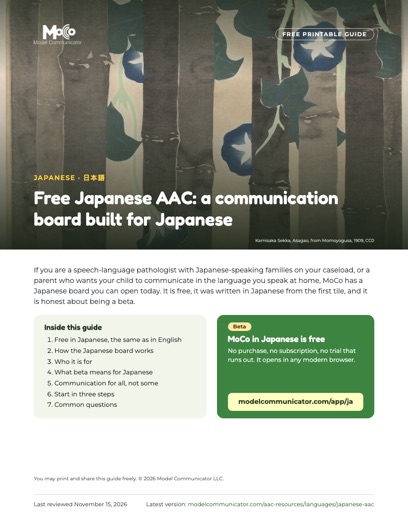

Free printable guide
Take this guide with you
Everything on this page as a 6-page PDF: how the board works, who it is for, what beta means, and how to start. Print it for a family or a team meeting, or share it.
How the Japanese board works
A translated English board gives a Japanese-speaking child English word order with Japanese labels, and no particles at all. This board keeps the MoCo layout (a frame of core words that never moves, around pages of topic words) and rethinks what goes in it for Japanese.
A frame made of what Japanese sentences need
The top row is ぼく · です · は · が · できる · を · この · と. Japanese has no articles and no “am, is, are”, so those cells hold the copula です and the particles は, が and を instead. The who column on the left is あなた · かれ · かのじょ · わたしたち, and the corner word is the particle に. The home page matches the English home page cell for cell, so a partner who knows the English board can find each idea in the same place.
Particles are tiles, and the board never guesses who did what
In Japanese the particle after a word says who did something and who it was done to. The communicator taps は, が, を or に from the frame, or taps a noun and picks its particle from the column beside the board. Even with automatic grammar turned on, the board adds no particle after a person or an animal, because a wrong guess could reverse who hit whom.
- みずがほしいI want water
- おなかがいたいmy tummy hurts
- ぼくはりんごをたべるI eat an apple
Every verb and adjective form is a press away
Verb tiles show the dictionary form (たべる, のむ, あそぶ), and request words show the て form (みて, まって, きて). Tap a verb and its forms appear beside the board: negative, want to, request and doing now, with the past forms one tap away on the tense key. Press and hold it and every form opens as tiles. Adjectives offer their negative and past the same way, and a setting called Polite forms puts the です and ます forms first for school.
- たべる → たべない, たべたい, たべて, たべたeat: do not eat, want to eat, please eat, ate
- おおきい → おおきくない, おおきかったbig: not big, was big
- たべますeat (polite)
The board says what was tapped
Automatic grammar is off unless you turn it on. The message shows exactly the words the communicator chose, so you can see their real language level and model the next step yourself. Families who want it can switch automatic grammar on in Settings. Set to change forms only, it changes word forms and adds nothing. Set to full, it also adds a particle where the words make it certain (みず and のむ become みずをのむ) and puts the verb last.
Written in kana, with no spaces
Every tile is in kana, the script a young child reads first: hiragana for Japanese words and katakana for loanwords. There are no kanji on the board. The message is written without spaces, as Japanese is. For partners who do not read kana, a setting shows romaji under each word.
- ジュースjuice (a loanword, in katakana)
- トイレいきたいI want to go to the toilet
- ママどこ?where is Mum?
A kana keyboard, counting words and わたし
The keyboard is the 50-sound kana table, with a second page for voiced and small kana and a romaji keyboard that completes to words on the board. Press and hold a number to count the Japanese way (ひとつ, ふたつ). With automatic grammar on, the board chooses the counter for the noun. The “I” tile says ぼく, and one setting changes it to わたし everywhere.
- りんごふたつtwo apples
- いぬにひきtwo dogs (with automatic grammar on)
- ぼくの → わたしのmine, in the two ways of saying I
Who it is for
Speech-language pathologists
You do not need to speak Japanese to get a family started. The home page matches the English board cell for cell, so what you know about modeling on MoCo carries over, and the family can model at home in the language they actually use. Because the board does not correct what was tapped, what you see in the message bar is what the child produced. There are three sizes: 60 tiles, and beta boards of 42 and 25.
Parents and families
Your child does not have to choose between Japanese and English. Children can learn AAC in two languages just as they learn to speak in two. Open the board, touch words as you say them during meals, play and bath time, and do not ask your child to copy you. You can start tonight, before any evaluation.
Bilingual classrooms and Japanese schools abroad
English and Japanese are separate boards with the same layout, each with its own settings. Settings switches between them. Turn on romaji under the tiles so that staff who do not read kana can still model, and turn on polite forms for talking with teachers.
What beta means for Japanese
The Japanese board has not been reviewed by a native Japanese speaker or by a Japanese-speaking speech-language pathologist, and it stays marked beta until it has been. It was drafted with AI from Japanese grammar and from knowledge of the words young children use most. English is the only MoCo board that has been fully reviewed.
Some limits to know about. The pictures are the same symbol set as the English board, so a few are approximate, and the particle tiles have no picture. The board has about 75 pages, enough for a young child’s day, where the English board has several hundred. There are no kanji and no furigana yet. Kana alone cannot tell apart words that sound the same, such as はな for nose and for flower. The who column holds pronouns that Japanese children rarely say; they use names, which you add with the editor. Some words may be more adult than a child would use, and a few holidays are loose fits. If a word is wrong for your family, tell us and we will fix it.
Communication for all, not some
Robust AAC is usually built in English first, and most of the world’s languages have none at any price. We think communication is a right, so every MoCo language is free, each is built for its own grammar instead of translated, and each carries an honest label saying how far its review has come.
Read our Communication for All plan and where each language stands
Start in three steps
Open the board
Go to modelcommunicator.com/app/ja in any modern browser. Choose a board size; the 60 is the full board.
Set how your family speaks
In Settings, choose whether the “I” tile says ぼく or わたし, turn on polite forms if the board is for school, and turn on romaji if a partner does not read kana.
Model during a routine
Pick one routine, such as a snack. Touch one or two words as you say the sentence aloud: もっと, たべる, ほしい. Keep going for weeks without expecting anything back. That is how AAC is learned.
Common questions
- Is the Japanese AAC board really free?
- Yes. MoCo is free in Japanese and in every other language it speaks. There is no paid version, no subscription and nothing to unlock.
- Is it a translation of the English board?
- No. The layout matches the English board so that bilingual users find ideas in the same place, but the words, the particles, the verb forms and the foods, places and holidays are Japanese.
- Will using AAC in two languages confuse my child?
- No. Research on bilingual children, including children with communication disabilities, has not found that two languages cause or worsen a delay. The American Speech-Language-Hearing Association advises supporting the home language.
- Which devices does it work on?
- Any device with a modern browser: Chromebook, Windows, Mac, Android tablets and phones, and Safari on the iPad. The Japanese board is not in the iPad App Store app yet.
- Why is the board in kana, with no kanji?
- Kana is what a young child reads first, so every tile is in hiragana or katakana. Kanji with furigana is not built yet. Adults who do not read kana can turn on romaji under each word.
- Does the board fix the grammar for my child?
- Not unless you ask it to. By default it says exactly what was tapped, and the communicator or the partner chooses particles and word forms. Automatic grammar can be turned on in Settings, and even then it never guesses who did what to whom.