
Free Portuguese AAC: a communication board built for Portuguese
If you are a speech-language pathologist with Brazilian or Portuguese families on your caseload, or a parent who wants your child to communicate in the language you speak at home, MoCo has a Portuguese board you can open today. It is free, it was written in Brazilian Portuguese from the first tile, and it is honest about being a beta.
Free in Portuguese, the same as in English
Model Communicator (MoCo) is a free AAC app built with a speech-language pathologist. The Portuguese board costs nothing, the same as the English one: there is no paid tier, and nothing is held back for later purchase. You do not need an evaluation, a funding request or an account to start.
It runs in the browser on a Chromebook, a Windows or Mac laptop, an Android tablet or phone, or an iPad in Safari. Portuguese is a web board for now; it is not inside the iPad App Store app. After the first visit it keeps working without a connection in that same browser, and you can add it to the home screen. It speaks with the Portuguese voices already on the device.
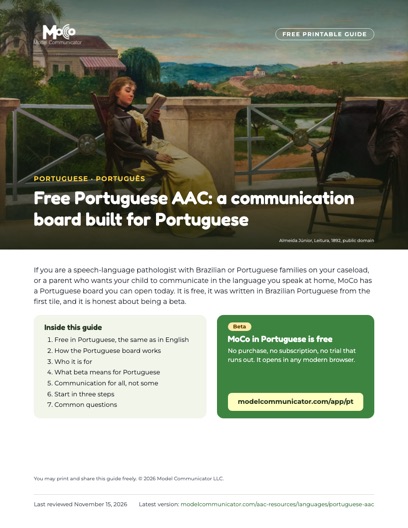

Free printable guide
Take this guide with you
Everything on this page as a 6-page PDF: how the board works, who it is for, what beta means, and how to start. Print it for a family or a team meeting, or share it.
How the Portuguese board works
A translated English board gives a Portuguese-speaking child English grammar with Portuguese labels. This board keeps the MoCo layout (a frame of core words that never moves, around pages of topic words) and rethinks what goes in it for Brazilian Portuguese.
The same frame as English, in Portuguese
The top row is eu · sou · é · está · posso · um · o · e, cell for cell where the English board has I, am, is, are, can, a, the, and. The who column on the left is você · ele · ela · nós, and the corner word is para. The home page matches the English home page the same way. A bilingual child who uses both boards finds each idea in the same place, and a partner who knows the English board can model on the Portuguese one right away.
Ser, estar and estar com
Portuguese has two verbs where English has “to be”, and children need both early: é for what something is, está for how it is or where it is. Both sit in the top row on every page. Hunger, thirst, sleepiness and fear are said the Brazilian way, with estar com, and the most common ones (com fome, com sono, com sede) are also single tiles.
- o cachorro é grandethe dog is big
- mamãe está aquimom is here
- estou com fomeI am hungry
Verb forms beside the board, with você built in
Verb tiles show the infinitive (comer, brincar, abrir), because the first sentence patterns take it: quero comer, posso brincar. Tap a verb and its forms appear beside the board: eu, você or ele, nós, and two past forms. In Brazil, você and a gente take the same form as ele, so one cell covers them. A tense key switches between agora, passado and futuro. Press and hold a verb and every form opens as tiles, including comendo and comia.
- quero comerI want to eat
- mamãe comemom eats
- comiI ate
- vou comerI am going to eat
The board says what was tapped
Automatic grammar is off unless you turn it on. The message shows exactly the words the communicator chose, so you can see their real language level and model the next step yourself. Families who want the board to finish agreement, contractions and conjugation for them (a casa vermelha, gosto do bolo, mamãe come) can switch that on in Settings, in full or for agreement only.
Gender, plurals, diminutives and contractions
Nouns offer their plural and their diminutive, which Brazilian children hear all day. Adjectives offer their feminine and plural, and articles their whole family (o, a, os, as, um, uma). The little words de and em carry do, da, no and na in their press-and-hold menu, so they can be chosen by hand. A setting lets a girl or woman speak about herself in the feminine.
- cachorro → cachorros, cachorrinhodog, dogs, little dog
- estou cansadaI am tired, said by a girl
- de → do, daof, of the
- obrigado / obrigadathank you, said by a boy or a girl
Brazil first, with a setting for Portugal
The default is Brazilian Portuguese, and Brazil keeps the pronoun (eu quero). One setting changes about 120 tiles, the label and what is spoken, to the words used in Portugal, and você in the who column becomes tu with its own verb forms. If automatic grammar is on, it follows Portugal too (tenho fome, estou a brincar). A page of polite requests carries o senhor and a senhora phrases for teachers and doctors.
- ônibus / autocarrobus in Brazil, in Portugal
- sorvete / geladoice cream in Brazil, in Portugal
- banheiro / casa de banhobathroom in Brazil, in Portugal
- o senhor pode me ajudar?can you help me? (formal)
Who it is for
Speech-language pathologists
You do not need to speak Portuguese to get a family started. The frame matches the English board, so what you know about modeling on MoCo carries over, and the family can model at home in the language they actually use. Because the board does not correct what was tapped, what you see in the message bar is what the child produced. There are three sizes: 60 tiles, and beta boards of 42 and 25.
Parents and families
Your child does not have to choose between Portuguese and English. Children can learn AAC in two languages just as they learn to speak in two. Open the board, touch words as you say them during meals, play and bath time, and do not ask your child to copy you. You can start tonight, before any evaluation.
Bilingual classrooms
English and Portuguese are separate boards with the same layout, each with its own settings and profiles. Settings switches between them. Once each has been opened in the browser, both keep working with no connection.
What beta means for Portuguese
The Portuguese board is a beta. It was drafted with AI from Portuguese grammar and from knowledge of the words young children use most. It has not yet been reviewed by a native speaker or by a Portuguese-speaking speech-language pathologist, and it stays marked beta until it has been. English is the only MoCo board that is fully reviewed.
Some limits to know about. The pictures are the same symbol set as the English board, so a few are approximate. The board has about 75 pages, enough for a young child’s day, where the English board has several hundred. Portuguese is not in the iPad app yet. The Portugal setting swaps words and verb forms, but the home page was chosen for Brazil. With Brazil selected, tu verb forms are not offered, which matters in parts of the South and the North-East. On some devices the first voice offered is European; pick a Brazilian voice in Settings. Names of family members, shows and favorite things are yours to add with the editor. If a word is wrong for your family or your region, tell us and we will fix it.
Communication for all, not some
Robust AAC is usually built in English first, and most of the world’s languages have none at any price. We think communication is a right, so every MoCo language is free, each is built for its own grammar instead of translated, and each carries an honest label saying how far its review has come.
Read our Communication for All plan and where each language stands
Start in three steps
Open the board
Go to modelcommunicator.com/app/pt in any modern browser. Choose a board size; the 60 is the full board.
Set the Portuguese your family speaks
In Settings, choose Brazil or Portugal under “Qual português?”, pick a voice that matches, and turn on feminine forms if the communicator is a girl or a woman.
Model during a routine
Pick one routine, such as a snack. Touch one or two words as you say the sentence aloud: mais, quero, comer. Keep going for weeks without expecting anything back. That is how AAC is learned.
Common questions
- Is the Portuguese AAC board really free?
- Yes. MoCo is free in Portuguese and in every other language it speaks. There is no paid version, no subscription and nothing to unlock.
- Is it a translation of the English board?
- No. The pages were written in Brazilian Portuguese, with Brazilian food, holidays and everyday words. The layout matches the English board so that bilingual users find words in the same place, but the words, the verb forms and the grammar are Portuguese.
- Will using AAC in two languages confuse my child?
- No. Research on bilingual children, including children with communication disabilities, has not found that two languages cause or worsen a delay. The American Speech-Language-Hearing Association advises supporting the home language.
- Which devices does it work on?
- Any device with a modern browser: Chromebook, Windows, Mac, Android tablets and phones, and Safari on an iPad. Portuguese is not yet in the iPad App Store app.
- Is it Brazilian or European Portuguese?
- Brazilian by default. A setting switches about 120 everyday words to the Portuguese of Portugal, and changes você to tu.
- Does the board fix the grammar for my child?
- Not unless you ask it to. By default it says exactly what was tapped, and the communicator or the partner chooses word forms. Automatic agreement and conjugation can be turned on in Settings.